Ingredients are consumed
Listed items are spent when the craft completes. They must be in the seeker's inventory. Two Wooden Planks means two separate planks, not one plank used twice.
Farm work happens in the Northern Village deck, on a field. The field must be claimed before it will support any of the crafts on this page.
A Crop Field is a village location large enough to build on. Standing in one is not enough. To install anything, the room must be part of an active claim owned by the current character, and it must not be contested.
A workstation supplies its service wherever it is, in the pack or set down on the floor. Installing it in a claimed room keeps it out of the pack and under the room's repair rules, and an installed one falls silent while the room is contested. Farm workstations are heavy. A Brewing Vat weighs 150 and a Kiln 180, so a farm is built rather than carried.
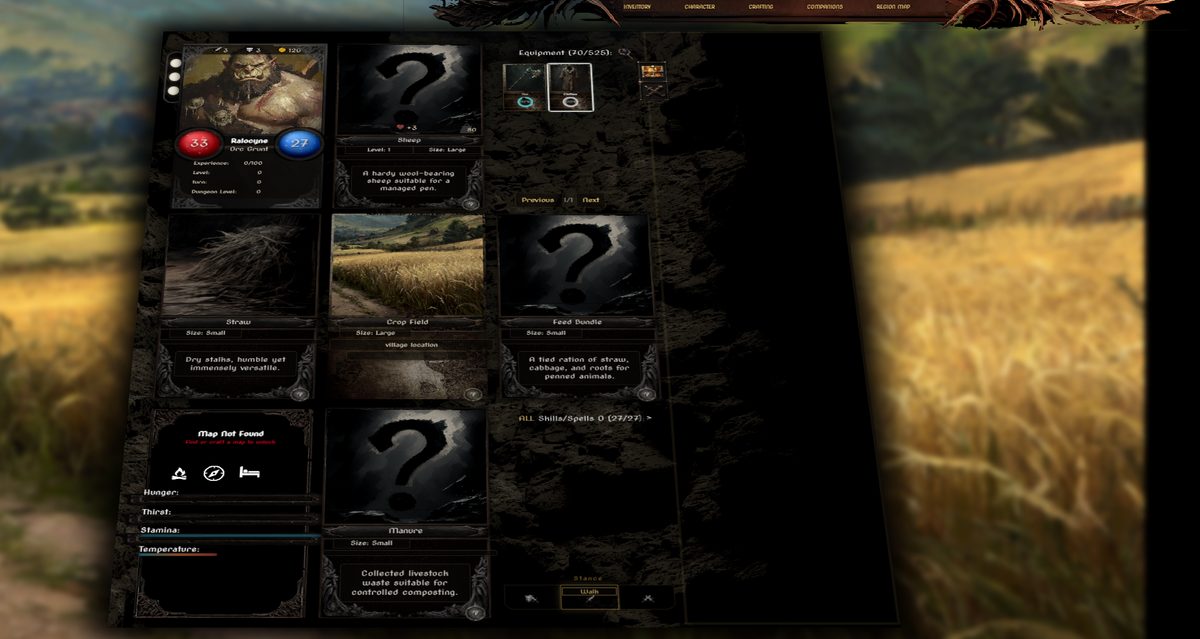
The ring of cards around the field is the raw material of everything that follows. The Sheep is livestock, and livestock is the only way to start a pen. The Feed Bundle is what an animal eats when it is penned. Straw and Manure are two thirds of a compost heap. None of them do anything on their own.
A recipe can ask for four different things, and they behave differently. Knowing which is which explains why a recipe refuses to offer the Craft Now button.
Listed items are spent when the craft completes. They must be in the seeker's inventory. Two Wooden Planks means two separate planks, not one plank used twice.
A required tool is checked but not spent. It may sit in the inventory, lie in the current room, or be installed in the room as a location improvement. Shears build a pen and remain afterwards.
Carpentry, cooking, drying, and brewing come from a workstation. It serves while carried, while lying in the room, and while installed. An installed one stops while its room is contested. Each craft wears the workstation that served it by one point.
Beast Master gates every pen. Carpenter gates the Churn and the Brewing Vat. Brewer gates everything past Young Mead. A perk cannot be borrowed or substituted.
When all four are satisfied, the recipe offers a Craft Now button. When any one is missing, the recipe still appears in the list, but the button does not. Every crafting screenshot on this page shows the button present, which is the proof that the requirement list beside it is complete.
A penned animal produces on a timer for as long as the claim holds. This is the only renewable food and fibre a seeker can own.
Sheep, Goat, and Hen livestock are found in the Northern Village. Each becomes a pen, and each pen is a Utility producer that belongs to the room it is built in. The livestock card is consumed by the build. There is no way to recover the animal once it is penned.
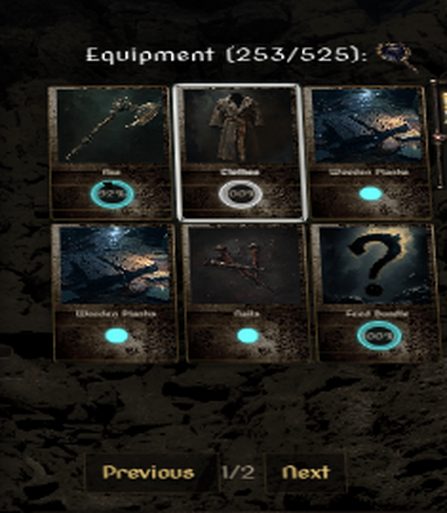
Four cards are spent: two Wooden Planks, Nails, a Feed Bundle, and the animal itself. Two more are only borrowed. The Shears are checked when the pen is built and stay in the inventory afterwards, ready for the next pen or for shearing a Sheep Skin directly into Wool. A hammer is needed too, and any hammer will do, so a war hammer already carried for fighting counts.
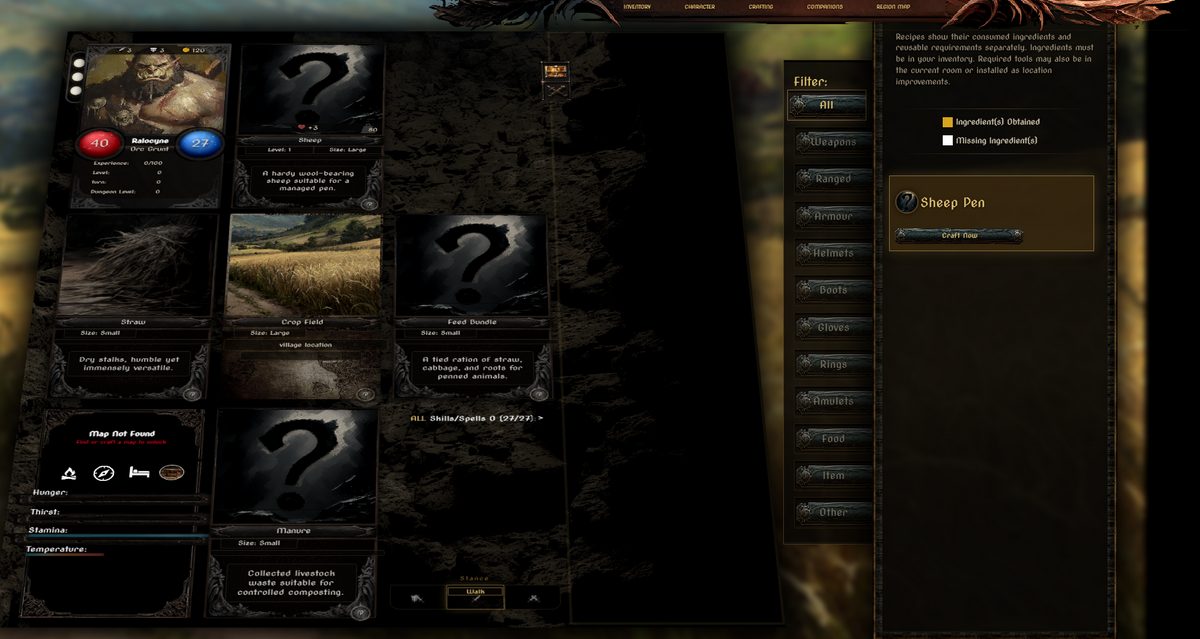
Goat Pens and Hen Coops are built the same way, swapping the animal. The difference is the clock and the yield. A Goat Pen renews a Bucket of milk every ten progress turns. A Hen Coop renews Eggs every eight. A Sheep Pen renews Wool every twelve.
Every production roll also carries a one in four chance of Manure instead of the usual yield. This is not a failure. Manure is the ingredient the compost heap is short of, and a farm that never produces any will run out of fertiliser before it runs out of anything else.
Each successful production wears the enclosure by one point. A pen is a structure with durability, and it will eventually need repair. Progress is retained if the claim is suspended, so leaving the farm for a spell does not reset the clock. A pen with nowhere to put its yield, because the room is full or something in it blocks production, holds the finished output instead of losing it, and takes no wear until it can deliver.
Compost is the simplest recipe on the farm and the one that makes the rest of it renewable.
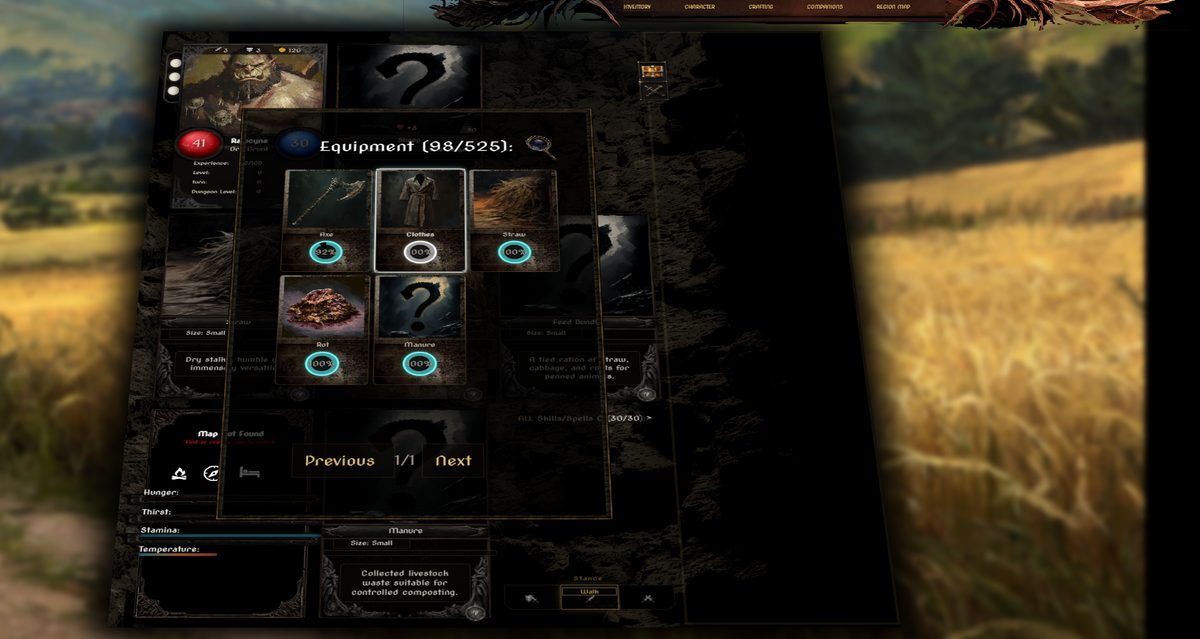
Rot is what spoiled food becomes. Manure comes from penned animals. Straw is common wherever crops are. All three are things a seeker would otherwise discard.
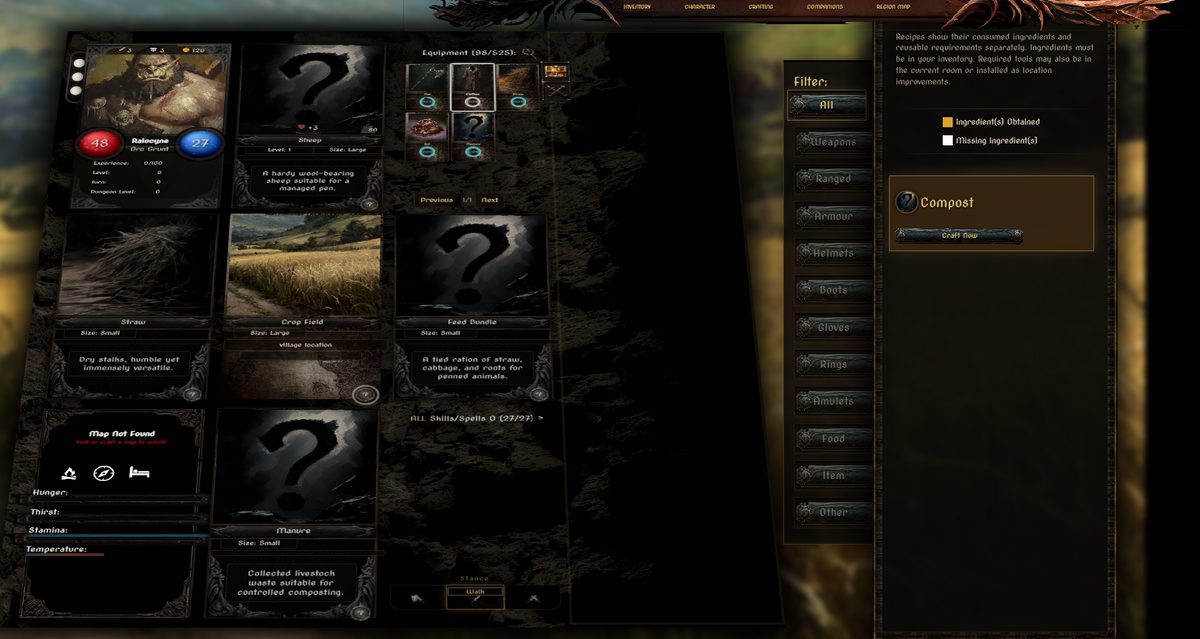
Compost is used by the Fertilize action. It is consumed, it marks the target as fertilised, and it doubles that target's next production progress. It is the renewable alternative to Rot, which is worth knowing because Rot is also the ingredient compost itself needs. A farm that fertilises with Rot directly is competing with its own compost heap.
Fertilising a pen shortens the wait for the next yield. Fertilising is where the one in four Manure rolls pay for themselves.
A Goat Pen produces a Bucket of milk every ten turns. Milk spoils. Butter, curds, and cheese do not, and each keeps differently.
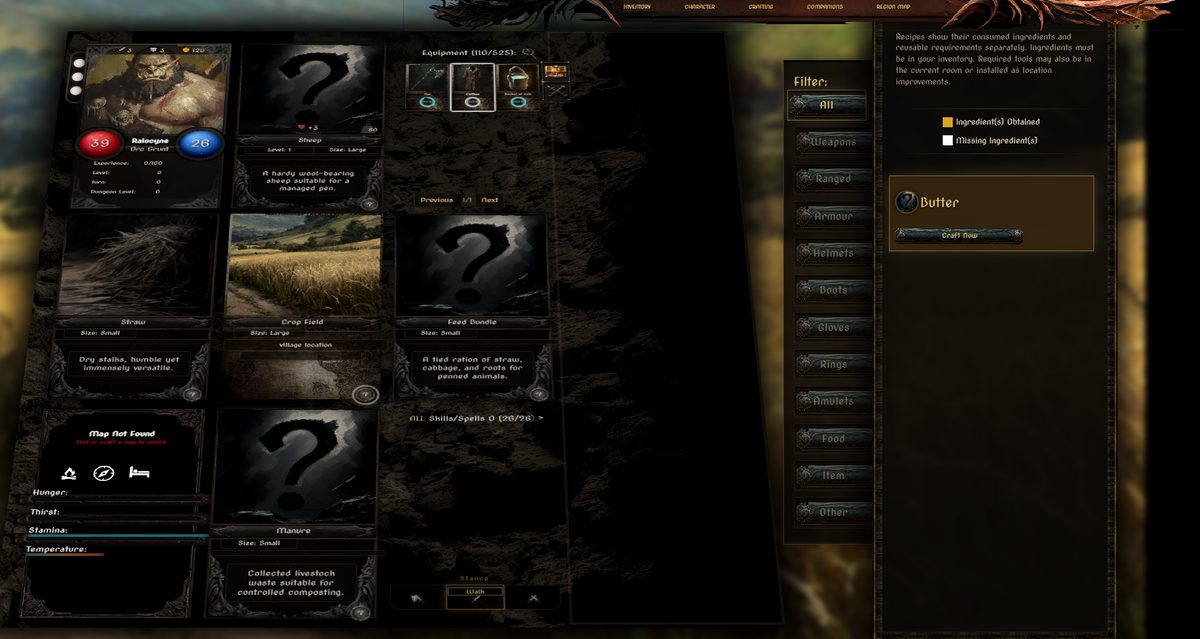
Once a Churn has been made, this is the cheapest thing to do with milk and it wastes none of it. The Churn is borrowed rather than consumed. Buttermilk is a byproduct of the same craft, not a second recipe. Butter goes on to enrich Preserved Trail Rations and Sealed Hearth Crocks, so a dairy is worth keeping even for a seeker who only cares about expedition food.
Curds are the other route, and they cost more. Souring milk requires Vinegar and a Storage Crock, and it requires a kitchen.
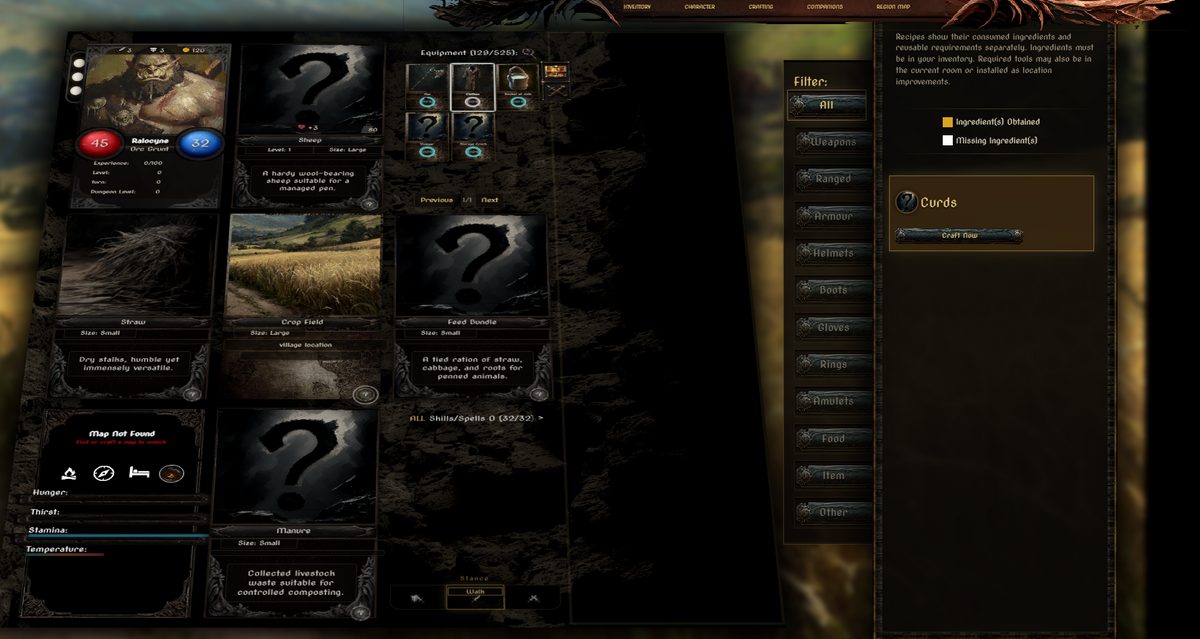
The Vinegar in this recipe is the reason brewing and dairy belong to the same farm. Vinegar is a brewing product, and it is consumed here. A steading that wants cheese needs a Brewing Vat as much as it needs a goat.
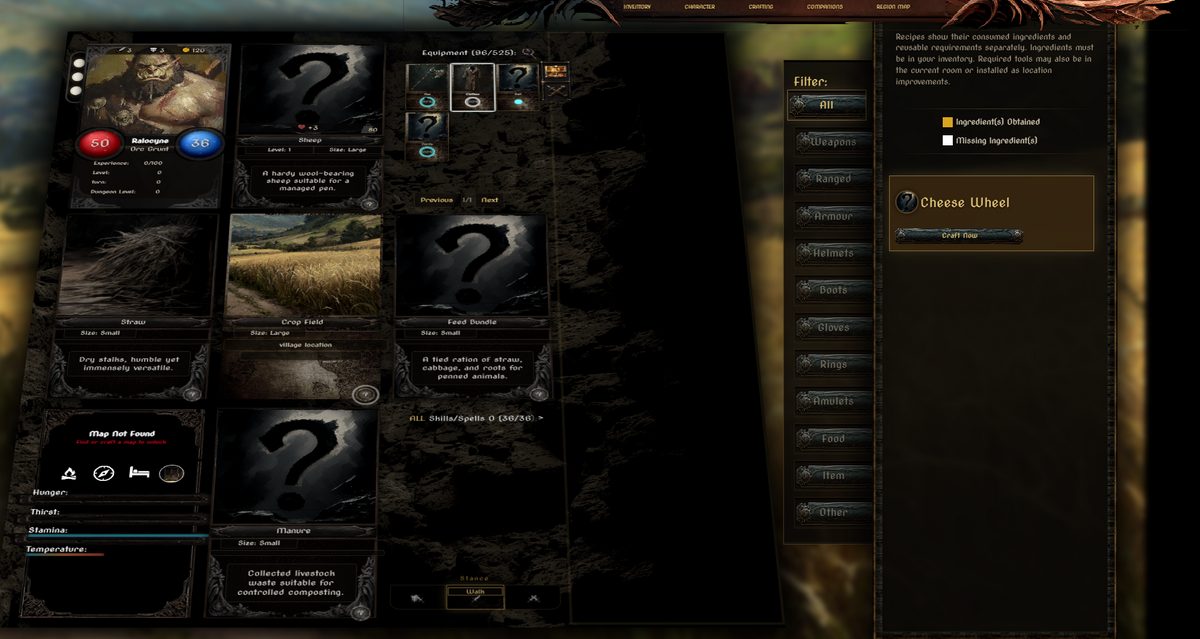
Cheese is the most durable food the farm makes, and the chain that produces it crosses three services. Milk comes from a pen built with carpentry, is soured in a kitchen, and is dried in a cabinet. A farm that only installs one workstation cannot finish it.
Brewing begins with a vat, and the vat is carpentry work. Nothing ferments until it stands in a claimed room.
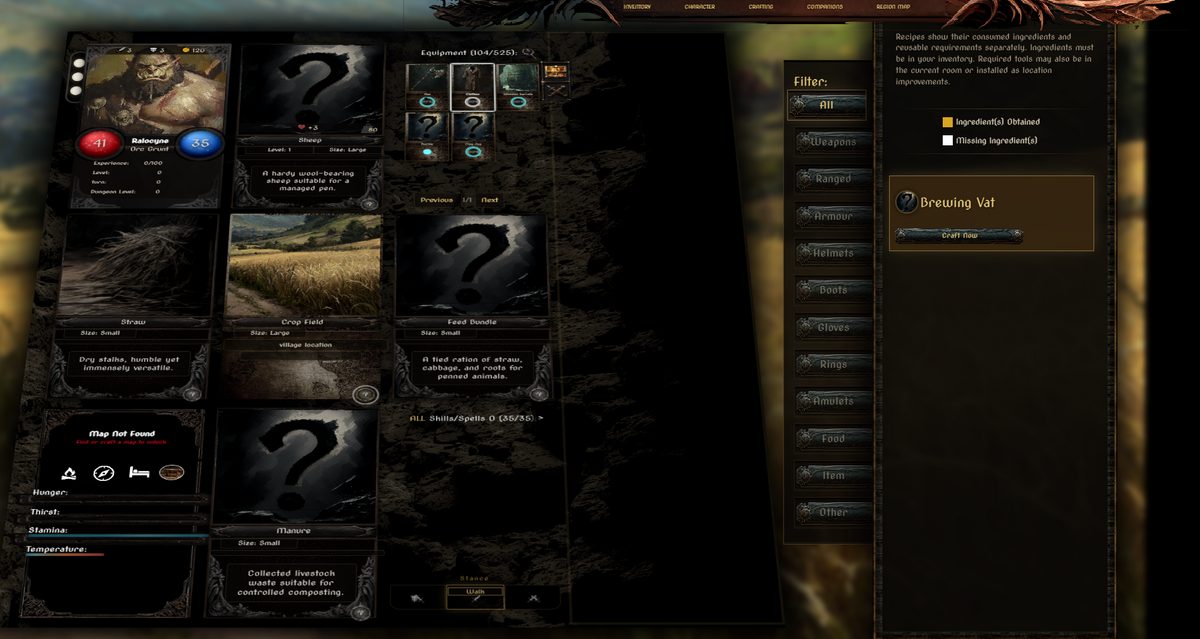
A Brewing Vat can be installed in a claimed kitchen, residential room, workshop, or storage room. It provides brewing only while it is intact, owned, and uncontested. Losing the claim to another party takes the service with it.
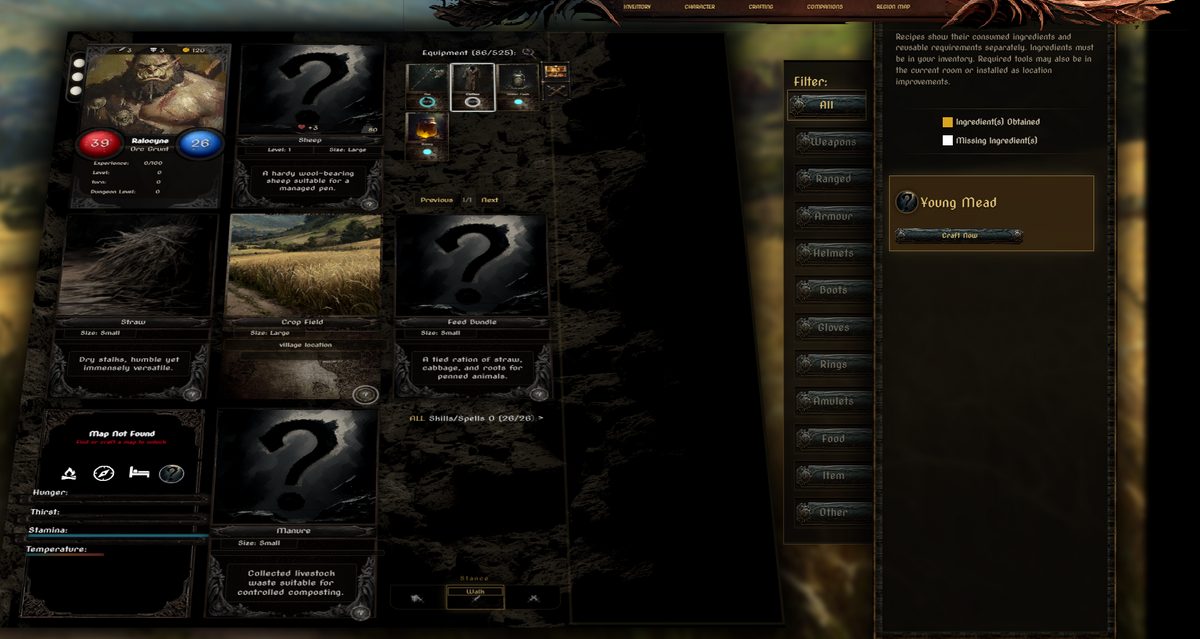
Young Mead is where an unperked seeker stops. Everything past it belongs to Brewer. Brewer finishes Young Mead into Mead, ferments Fruit Mash and Water into Wine, and turns Wine into Vinegar.
Vinegar is the reason to keep brewing after the drinks are made. It is consumed by dairy, pickling, medicine, and soap. A vat that has stopped producing anything worth drinking is still the only source of the ingredient the cheese chain needs.
Fermentation is instant. It uses the normal service rules and does not run on a separate timer the way a pen does.
The farm has one bottleneck, and it is carpentry. Almost everything else waits on it.
An unclaimed field takes no improvements. Claiming is the prerequisite for installing every workstation on this page, and the farm is heavy enough that installing is the only practical way to keep its services. Compost and Butter need no service, although Butter still requires a reusable Churn.
Pens, the Churn, and the Brewing Vat are all carpentry work. A single carpentry workstation unlocks the whole construction side of the farm.
Milk is not found, it is produced. A Goat Pen is the only reliable source, and it takes ten turns per bucket.
Curds need Vinegar, and Vinegar is a brewing product gated behind Brewer. Cheese is the last thing a farm learns to make.
Compost and Butter are the two service-free exceptions worth remembering. Compost needs only its ingredients. Butter needs a reusable Churn, but neither recipe requires claimed ground or a perk.