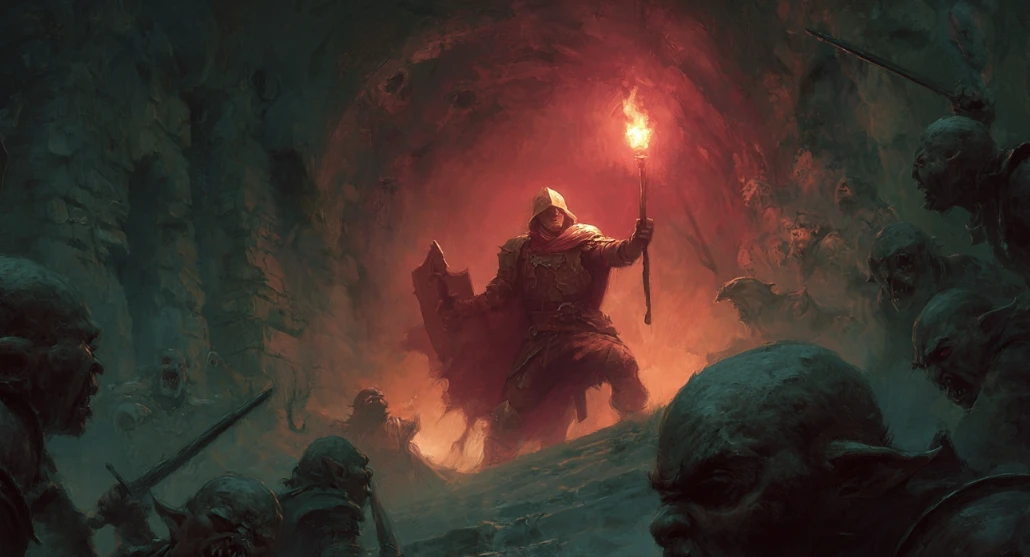
Combat in Ethernalis is short and dangerous. Every attack spends stamina, every enemy you strike can strike back, and wounds last after the fight is over. The heroes who survive pick their moment, choose where to hit, and leave before a bad fight gets worse.
Read the distance
When you walk into a room, the card on the side you came in through is right beside you. The other three start one to three steps away. A Perception of 5 keeps them a step further off, and a Perception of 1 lets them a step closer. Each enemy card carries a marker showing how many steps away it is.
Each turn an enemy that is coming for you closes one step. Attacking a distant enemy with a melee weapon first spends your action closing the gap. Only a creature standing right beside you can be struck.
Expect a counter-attack
Every time you swing at an alert enemy standing right beside you, hit or miss, it may strike straight back with one attack. The chance depends on the creature. Most can counter, around 30% of the time on average, and a few counter every single time.
Shooting a creature at a distance can draw return fire in the same way, if it has a ranged attack of its own. A creature that has not noticed you never counters, which is why the first blow from hiding is so valuable.
Attacks of opportunity
When you walk out of a room, every alert enemy right beside you gets a chance at one free attack as you turn your back. The chance is its counter-attack rating plus 30%. Enemies still at a distance cannot do this, unless they have a ranged attack that reaches you.
Creatures that have not noticed you, and creatures that are stunned, never get a free attack. Before you leave, the game shows a Leave Anyway? warning listing every creature that could strike and its chance to do it.
Which way is safe to go
Each of the four cards around you sits in one of the room's exits. Walk out through a side where a creature stands and you have to squeeze past it. It then gets its chance at a free attack however far away it was.
The card on the side you came in through starts right beside you. If a creature waits there, going back the way you came means passing within its reach.
The safe way out is an exit with no creature in it, taken while every alert creature is still at a distance. The longer you stay, the closer they get, so decide early. If you must pass one, stun it first, or sneak so it never notices you. Watch for traps in the exit too; see How to Deal with Traps and Locked Doors.
Stamina is your budget
Every swing costs stamina, set by your weapon, and a miss costs the same as a hit. With too little stamina left, your attack misses outright. Running, and standing in smoke or flood water, drain stamina too.
Recover it by resting with Stay when no one is hitting you. Before you start a fight, check that you have enough stamina to finish it.
Land your blows
Your chance to hit is your Melee minus the enemy's Dodge, as a percentage. A normal hit deals your Strength plus a die, less the enemy's Defence. A critical hit ignores Defence entirely, which is why a critical chance is worth building.
A weapon you are not trained to use works at half strength. Check your proficiencies before you trust your life to a new blade.
Strike first, from hiding
Switch to sneaking before you enter a room. Each step you take while sneaking tests your Sneak skill against every creature that has not already turned on you. Pass and it stays unaware of you. Walking or running normally gives you away to any creature that has not noticed you yet.
An unaware creature does not attack you and does not strike back. Your first blow against it lands unanswered, and your Sneak skill is added to your critical chance for that blow. After that it is alerted, and you cannot hide from it again for 10 turns.
Sneaking gives +10% to Melee, Ranged, and Dodge, but costs 1 stamina every action unless your Dexterity is 5.
Aim where it hurts
The quick attack from the right-click menu lands on a random body part. For a chosen target, turn the enemy card and use its Attack action. Heads and bodies are harder to hit and deal more damage. Limbs, wings, and tails are easier to hit and deal less.
A hit to the head of a humanoid, rat, wolf, bat, or snake is more likely to stun it. The undead cannot be stunned. A heavy blow to a limb can sever it and weaken the creature for the rest of the fight, and a hit to a humanoid's arm can knock its weapon away.
Use your range
A ranged weapon works only while the target is still at a distance, and only while nothing is fighting you up close. Each weapon has a maximum range, and most need ammunition.
The best time to shoot is as a creature walks toward you. Loose what you can, then switch to melee when it arrives.
Know when to run
Running gives +10% to Melee, Ranged, and Strength and an extra action point on your first move each turn, but costs 10% of your Defence, Dodge, and spellcraft. It also drains 1 stamina every action unless your Endurance is 5. When your stamina runs out, you stop running.
Do not fight every creature you see. A creature that has not noticed you will not follow you. But do not leave an enemy alone for long either. Every creature grows stronger for each turn it stays alive.
After the fight
Check your body for lasting wounds. A restored Health bar does not mean the injury is gone. See How to Treat a Wound. Then rest and eat before you move on.