Traps lie hidden in rooms and inside chests. Locks bar doors and containers. Both can be dealt with in more than one way, and the right choice depends on your hero. A patient hero with steady hands disarms and picks. A strong one forces the way through.
How checks work
Many of these actions test one of your Measures. You roll one die for each point in it. Every 4 or higher is a success and every 1 cancels one. You need at least one success left. A Measure of 4 or 5 passes most of the time, and a Measure of 1 rarely does.
Spot the trap first
A hidden trap looks like nothing at all until it springs. To find one, rest in place with Stay. Each rest makes a Perception check against every hidden trap in the room, including traps inside chests. Traps are well hidden, and even a passed check often misses one, so rest more than once in a room you do not trust.
A trap you have spotted stays marked on its card. Practice finding traps raises your trap proficiency, which makes disarming easier.
What a trap does
A trap lying on one of the four sides of your room guards that way out. Try to leave through it and you must pass a Dexterity check. Fail and the trap strikes you. Either way, a sprung trap costs you the move and you stay where you are. Dropping something onto a trap sets it off too.
Knowing where a trap is does not make the way safe. You still have to pass its check to walk through. A trap hidden in a chest fires when you open the chest, but one you have already spotted will not.
A trap that has sprung stays sprung until someone resets it.
Disarm it
Once a trap is spotted, Attempt to disarm it. This tests your Dexterity, then your Patience, and each level of trap proficiency adds a die to both. You need to pass both. A failed attempt does not set the trap off, so you can keep trying while you have action points.
A disarmed trap is safe to walk past and can be picked up and carried away.
Turn traps against the dungeon
Drop a trap you carry into a room and it is armed and ready. Reset trap re-arms one that is disarmed or has already sprung. Creatures that walk into an armed trap may spot it and step aside. If they do not, it hits them, and a strong trap can kill.
A trap on the way into your camp is a cheap guard for the night.
Find the key
Every locked door has a key somewhere in the dungeon, lying in a room you can reach without passing that door. Use the key from your pack while standing next to the locked room. It opens the lock and is used up. A key that fits nothing here stays in your pack, but the attempt still costs an action point.
Locked chests hold something better than usual, often an enchanted item. Their keys, Small Brass Keys, are carried by creatures in the same dungeon. Kill the right one and you get the key. Some locks answer only to their own key and cannot be picked or forced.
Pick or force a chest
No key? Choose Break Lock on a locked chest. It costs 1 action point.
If you carry Lockpicks, you pick the lock. The chance is 5% plus your Dexterity, and each level of lockpicking proficiency adds 5% more. Every attempt wears the picks down, and a set lasts 10 attempts. Each lock you open teaches you a little more.
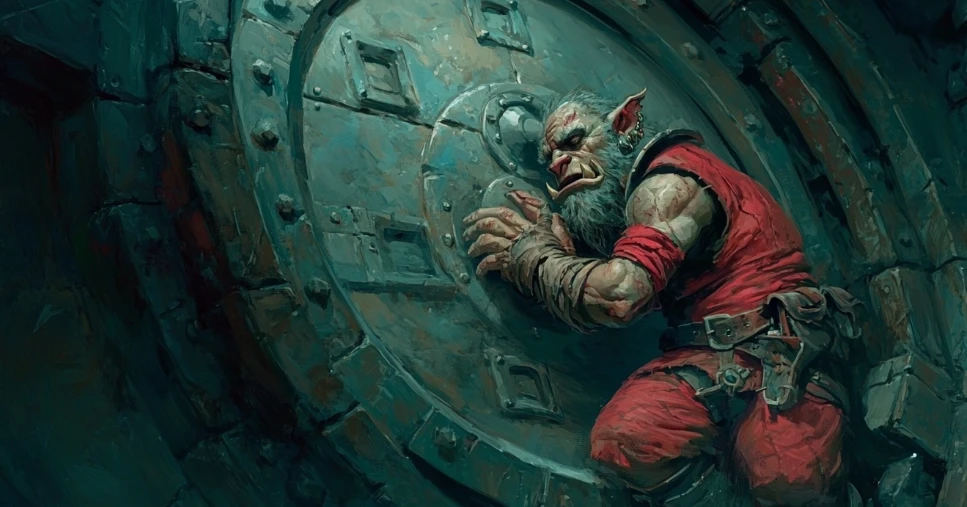
Without lockpicks, you force it. The chance is your Strength plus the strength of the weapon in your main hand, as a percentage. Every failure costs that weapon 1 durability, so a heavy weapon helps and a fine blade suffers.
Break down a door
Walking into a locked room without its key makes you throw your weight against the door. There is a small chance, based on your Strength, that it gives way. Most of the time, finding the key is faster.