Dealt Heroes
Three ready-made heroes are dealt. Each shows their race, class, alignment, proficiencies, personality traits, and what they carry. Choose one and press Begin Your Adventure.
A run begins in two steps. First choose or create your hero. Then choose where on the region map they begin.
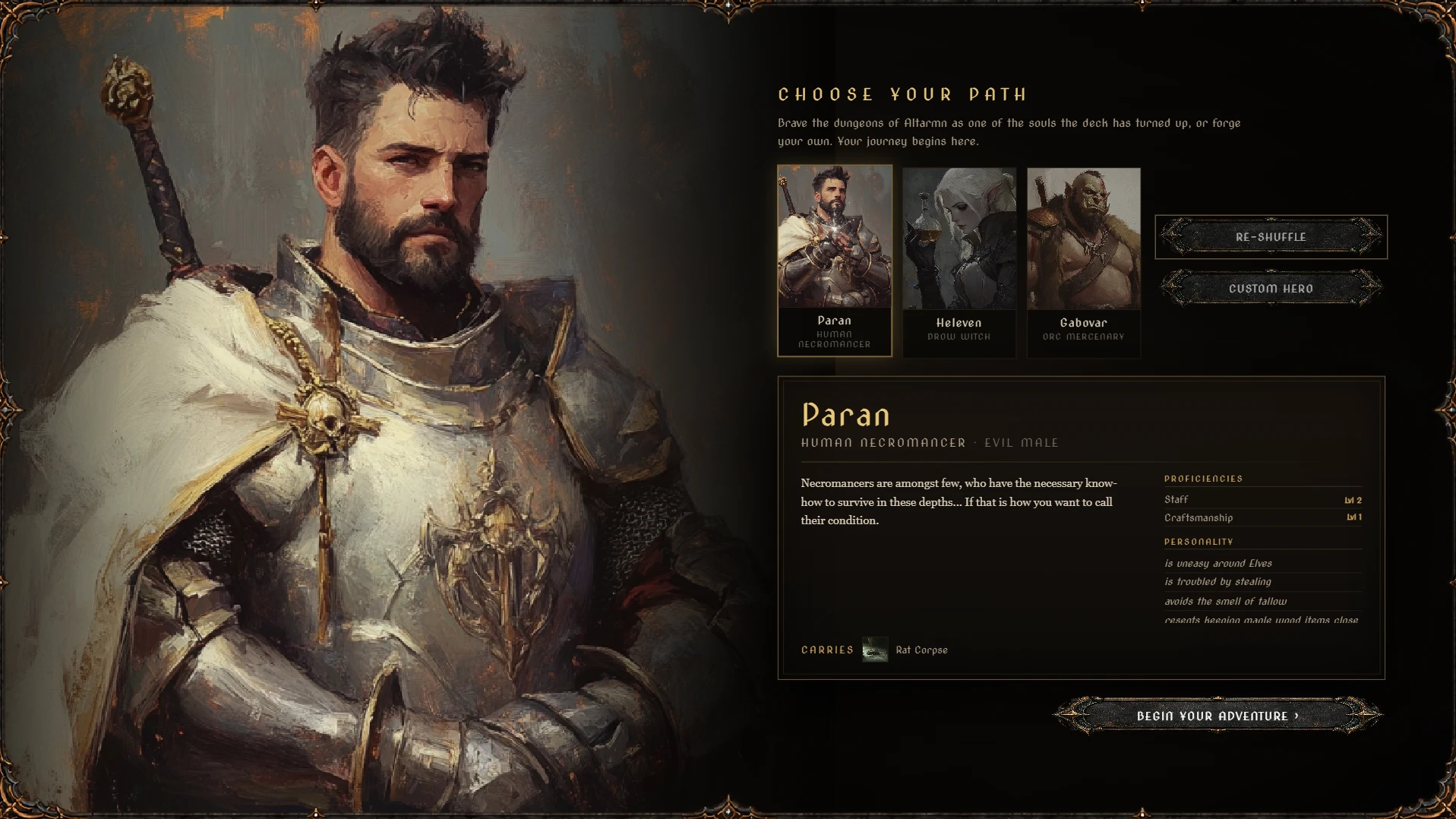
Three ready-made heroes are dealt. Each shows their race, class, alignment, proficiencies, personality traits, and what they carry. Choose one and press Begin Your Adventure.
Not taken with any of them? Re-shuffle deals a fresh hand of three. You can deal as often as you like.
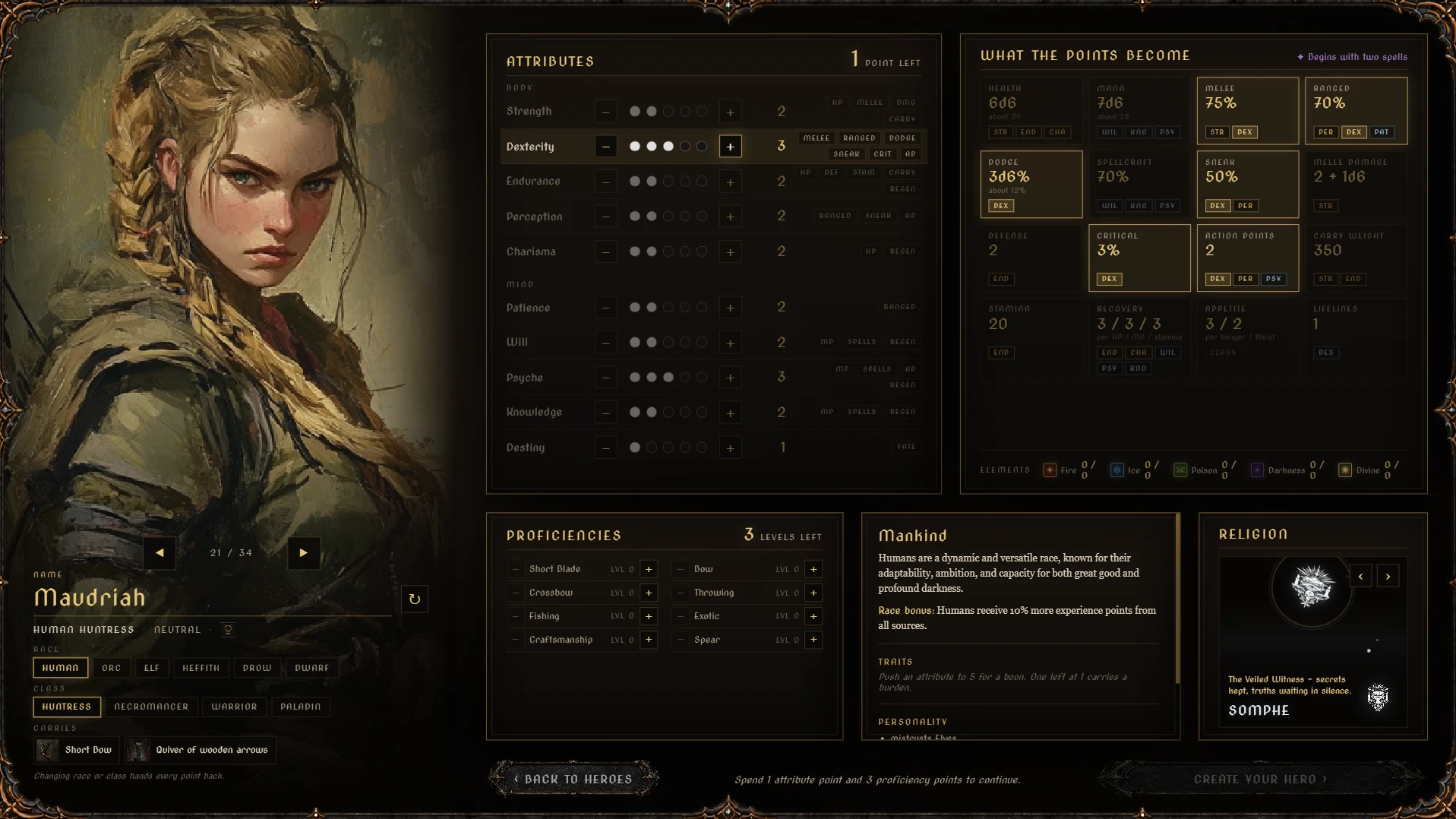
Custom Hero opens the full form. Choose race, class, portrait, Measures, proficiencies, and deity yourself, then press Create Your Hero.
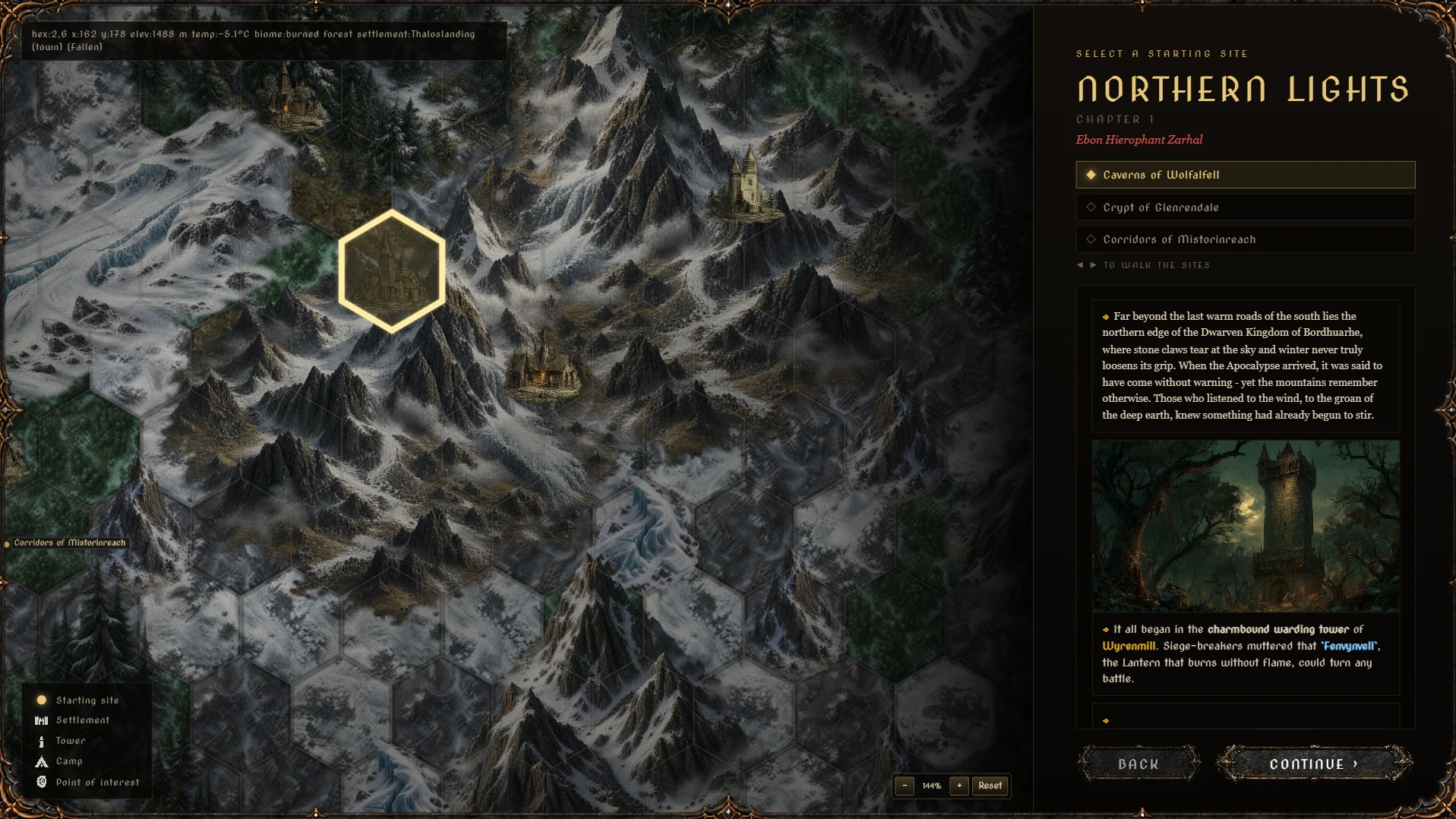
Your hero enters a region with its own map, its own chapter, and a history written before you arrive. Settlements, towers, camps, and points of interest are marked on it.
Three starting sites are offered, each with its own story. Click one, or use the arrow keys to walk between them. The site decides what kind of dungeon the run begins in.
Press Continue to descend into the chosen site. Back returns to the heroes if you want to change your mind.
Race describes inherited nature. Class describes learned practice. Together they set the starting profile, but neither locks the character into one final path.
Each race sets a floor under one Measure and adds its bonuses at birth, on dealt and custom heroes alike. The race pages in First Steps describe their identity and homeland.
A starting class determines the character's early strengths and the class choices offered at later levels. Measure points left unplaced are assigned at random, so two dealt heroes of the same class can differ.
Level-up choices can retain a vocation or turn it toward a new one. The class reference lists every branch and reward.
| Race | Never Below | Born With |
|---|---|---|
| Human | No minimum | No Measure bonus. Humans earn 10% more experience from every source. |
| Elf | 3 Charisma | +1 Charisma, +1 Dexterity, and 2 dark defence. |
| Drow | 3 Will | +1 Will, +1 Dexterity, and 2 holy defence. |
| Orc | 3 Strength | +1 Strength, +1 Endurance, and the Consumer perk, which lets rocks and metal count as food. |
| Dwarf | 3 Endurance | +1 Endurance, +1 Knowledge, and double stamina. |
| Heffith | 3 Dexterity | +1 Dexterity, +1 Perception, one random perk already unlocked, and one mutation already taken hold. A Heffith grows another mutation with every level. |
The Ten Measures describe capability. Extreme values also create defining gifts and weaknesses, while personality traits describe what brings comfort or distress.
A measure raised to its highest creation value grants a powerful positive trait tied to that ability.
A measure left at its lowest creation value grants a serious weakness. These burdens can change what actions are possible.
Three to five preferences and aversions are shaped by race and class. Harder traits repay some of their burden with extra measure points.
The custom hero form sets race, class, portrait, Measures, proficiencies, and deity. A name is rolled for the hero, and you can roll it again. Its preview of every derived stat already includes the racial bonus, and hovering a Measure lights the stats it feeds.
A Measure holds at most 5 at creation and cannot be lowered below its racial floor. Create becomes available only when every Measure point and proficiency point is spent. Changing race or class hands every point back.
The deity chosen on the form claims the hero, with piety starting at 0. A hero who chooses None begins unclaimed.
A character begins with gear suited to their origin and vocation. Destiny measures the rare protection of fate and can turn a fatal moment into a final trial.
Weapons, clothing, supplies, and class tools form the first inventory. Every hero also wears a pair of poor quality old boots and a pair of trousers. They add almost no protection, but they keep a new character from freezing. They are ordinary items and remain subject to weight, durability, and loss.
Destiny influences fortunate outcomes. When a destiny point can answer defeat, it is spent to pull the character into a Destiny Trial instead of ending the run.
The starting site chosen on the region map decides where the character begins and what kind of dungeon they first enter. Dungeons from earlier runs stay on the map and are reached by travelling there, not by starting there.